BLD Pharm offers a comprehensive portfolio of targeted protein degraders, including PROTACs, molecular glues, and building blocks (linkers & E3 ligase ligands), for chemical biology and oncology research.
Targeted protein degradation has rapidly emerged as a transformative strategy in modern drug discovery, eliminating disease-associated proteins from cells by harnessing the cell’s own degradation machinery rather than merely inhibiting protein activity. Among the technologies in this field, PROTACs (Proteolysis-Targeting Chimeras) have gained significant attention from both academic researchers and the pharmaceutical industry, offering new opportunities to study protein function and target previously “undruggable” proteins.
PROTACs are heterobifunctional small molecules designed to induce the degradation of a specific protein of interest. A typical PROTAC molecule consists of three components:
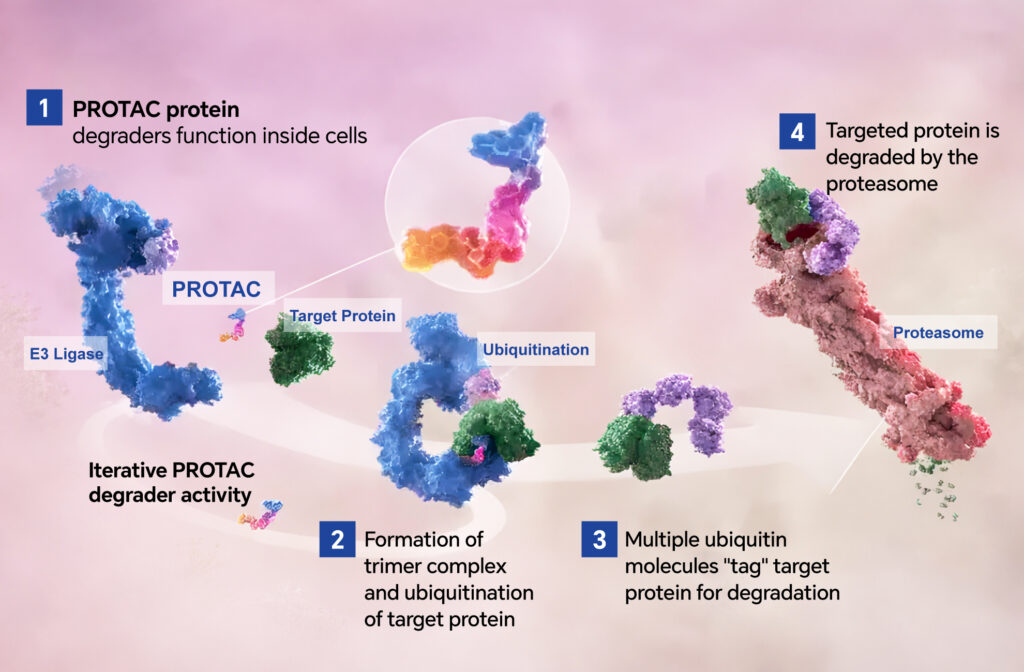
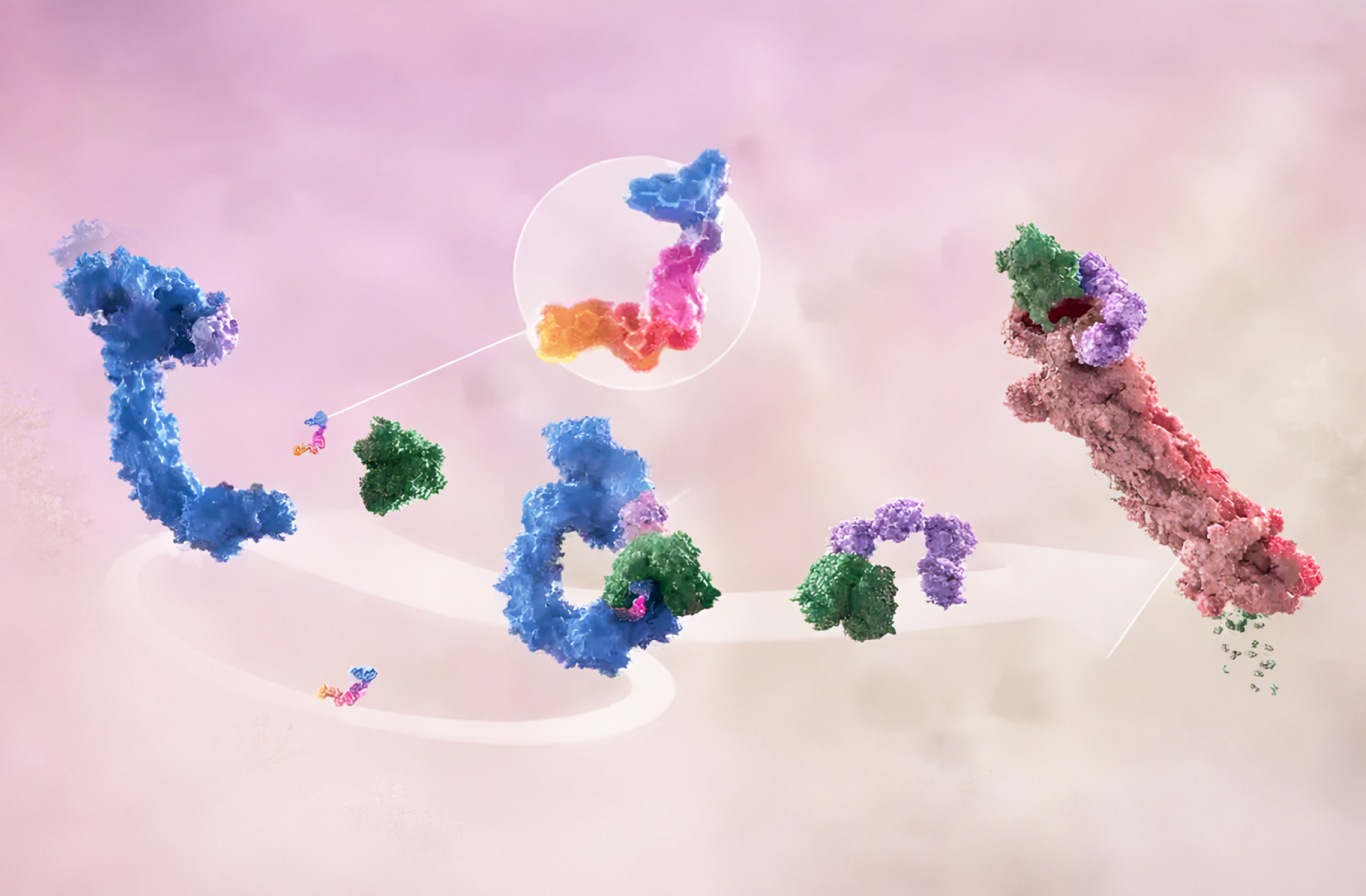
These molecules ubiquitinate the target protein (POl) by harnessing the effector enzyme (E3), causing the POl to be degraded by the proteasome, thereby down-regulating the expression level of the protein.
In contrast to classical small-molecule inhibitors that block protein activity, PROTACs degrade the protein entirely in the cell, offering a different mechanism of action.
Beyond their novel mechanism, PROTACs have enabled the targeting of proteins that were previously considered difficult to drug, including transcription factors and scaffolding proteins. By bringing the target protein into proximity with an E3 ligase, PROTACs trigger ubiquitination and proteasomal degradation, rather than merely blocking activity. Over the past decade, this strategy has been successfully applied to a wide range of disease-relevant proteins, from kinases and transcription regulators to signaling molecules, illustrating its potential to expand both biological understanding and therapeutic possibilities.
Although conceptually elegant, the design of effective PROTAC molecules presents several chemical challenges. Compared with traditional small molecules, PROTACs are typically larger and structurally more complex. Their activity depends on multiple parameters, including:
Small changes in linker composition or ligand orientation can significantly influence degradation efficiency. As a result, medicinal chemists often need to synthesize and evaluate multiple structural variants during optimization.
The rapid development of targeted protein degradation has created a growing demand for specialized chemical tools that support PROTAC design and synthesis. BLD Pharm provides a comprehensive range of these tools, including E3 ligase ligands, functionalized linker building blocks with varying lengths and properties, E3 ligand-linker conjugates, and small-molecule intermediates and compounds suitable for modular assembly.
With access to such diverse and well-characterized building blocks, researchers can more efficiently explore PROTAC chemical space, streamline design strategies, and ultimately accelerate degrader discovery.
| Catalog number | Product Name | Target |
| BD00778791 | ARV-771 | BET |
| BD01888398 | CFT-8634 | BRD9 |
| BD01928862 | NX-2127 | BTK |
| BD01394417 | ARV-471 | ERa |
| BD01609412 | KT-474 | IRAK4 |
| Catalog number | CAS | Type |
| BD560662 | 1448297-52-6 | VHL |
| BD02564387 | 2821795-71-3 | VHL |
| BD01136668 | 2303193-99-5 | VHL |
| BD00862360 | 835616-60-9 | CRBN |
| BD235626 | 19171-19-8 | CRBN |
| BD01159556 | 191732-74-8 | CRBN |
| BD01143319 | 1267337-47-2 | CRBN |
| BD01538638 | 2446913-88-6 | CRBN |
| BD01307445 | 2300099-98-1 | CRBN |
| BD | CAS | Type |
| BD00815828 | 2140807-17-4 | Pomalidomide-PEG2-COOH |
| BD00827285 | 2138440-81-8 | Pomalidomide-PEG4-COOH |
| BD01108706 | 2139348-63-1 | Pomalidomide-PEG5-COOH |
| BD01108899 | 2305369-00-8 | Pomalidomide-C2-NH2 HCl |
| BD01584963 | 2446474-05-9 | Pomalidomide-C7-NH2 HCl |
| BD01301963 | 2271036-44-1 | Pomalidomide-PEG1-N3 |
| BD01203697 | 2271036-47-4 | Pomalidomide-PEG4-N3 |
| BD01426440 | 2172820-07-2 | (S,R,S)-AHPC-PEG1-COOH |
| BD01435400 | 2172820-09-4 | (S,R,S)-AHPC-PEG2-COOH |
| BD01377007 | 2140807-42-5 | (S,R,S)-AHPC-PEG3-COOH |
| BD01519710 | 2172819-72-4 | (S,R,S)-AHPC-C2-COOH |
| BD01391554 | 2162120-87-6 | (S,R,S)-AHPC-C5-COOH |
For more information on our PROTACs, E3 ligase ligands, and linker-conjugates, you can find these products in our webshop or order them by emailing us or submitting the contact form on our contact For tailored advice on product selection or experimental design, please reach out to our technical support team or your account manager.


Building Blocks | Pharmaceutical Intermediates | Inhibitors and Agonists | Amino Acids and Peptides | XDC Fragments | PROTACs | Nucleosides & Nucleotides
We gladly support you by keeping you updated on our latest products and developments