A ChIP experiment is only as reliable as its antibody. Atlas Antibodies has validated more than 750 antibodies by ChIP-Exo-Seq, mapping protein-DNA interactions at single base-pair resolution.
A chromatin immunoprecipitation (ChIP) experiment asks a deceptively simple question: where, across three billion base pairs of DNA, does your protein of interest actually bind? The answer depends entirely on one reagent: the primary antibody. An antibody that cross-reacts with off-target proteins pulls down the wrong DNA. An antibody whose epitope is masked by crosslinked chromatin pulls down nothing at all. Either way, weeks of sequencing and analysis are spent chasing noise.
This is why application-specific validation matters. An antibody that performs beautifully in Western blot has not thereby earned its place in a ChIP protocol. It has to be tested in chromatin, under crosslinking, in complex with DNA, against a non-specific IgG control.
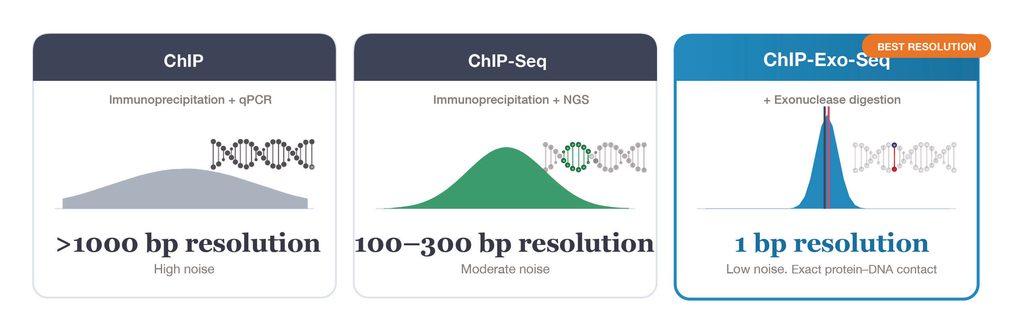
ChIP, ChIP-Seq, and ChIP-Exo-Seq all start with the same step: immunoprecipitating a protein bound to DNA. They differ in how precisely they map the binding site and how much background they produce:
Figure 1 shows these differences side by side. All Atlas Antibodies ChIP-validated antibodies are validated with ChIP-Exo-Seq, the highest of the three levels.
Atlas Antibodies validates its ChIP-grade antibodies using ChIP-Exo-Seq, developed in collaboration with the laboratory of Prof. B. F. Pugh at Cornell University a pioneer of the ChIP-exo method.
ChIP-Exo-Seq adds an exonuclease digestion step to conventional ChIP-Seq: the enzyme trims unprotected DNA in the 5′→3′ direction and stops precisely at the protein-DNA crosslink. The result is sharp, strand-specific peaks marking exact binding sites at 1 bp resolution, with background DNA removed rather than merely averaged out.
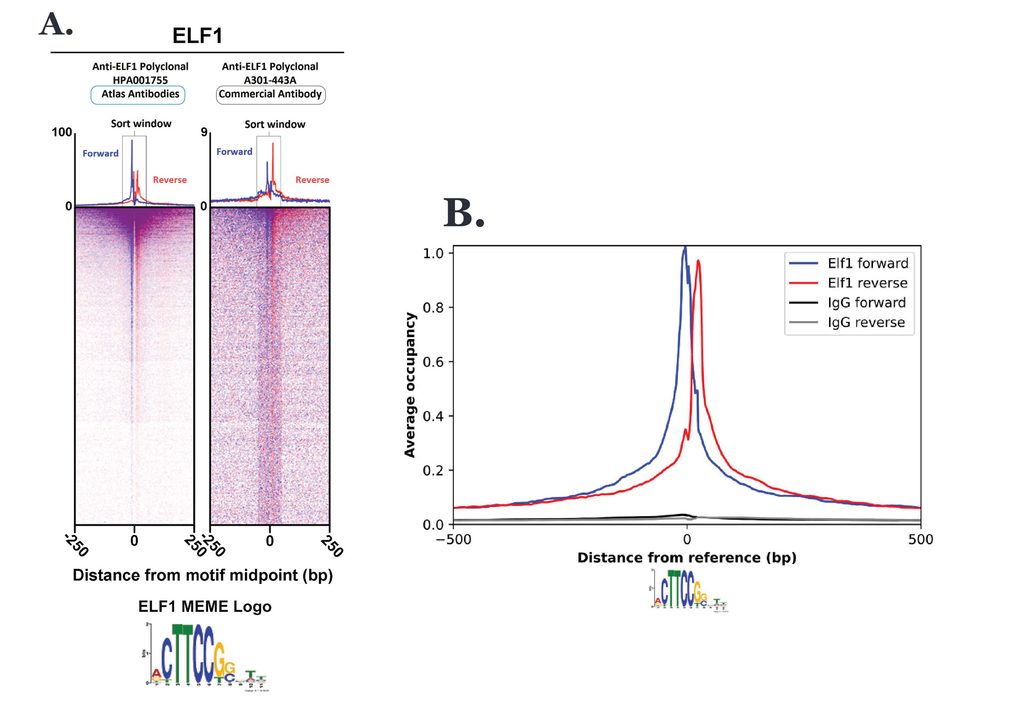
The table below highlights ten widely studied chromatin-associated targets from the Atlas Antibodies ChIP-validated collection; each an affinity-purified Triple-A Polyclonal™.
The collection now spans more than 750 ChIP-validated antibodies against transcription factors, RNA polymerase II subunits, chromatin remodellers, and transcription-associated proteins, supported by peer-reviewed citations in the literature.
Every antibody carries an HPA identifier. Enter it at proteinatlas.org and the underlying characterization data (tissue profiles, cell line data, and application evidence) is openly published and freely browsable. Validation, in other words, is not a claim to take on trust; it is a record you can check before the antibody ever reaches your bench.
| Target | Catalog ID | Research area |
|---|---|---|
| WT1 | HPA053848 | Cancer biology · nephrology |
| EGR1 | HPA029938 | Neuroscience · cancer |
| ELF1 | HPA001755 | Immunology |
| ELK4 | HPA028863 | Cancer biology |
| CEBPE | HPA002928 | Haematology |
| NELFA | HPA043931 | Gene regulation |
| POLR2C | HPA041826 | Core transcription machinery |
| EP400 | HPA049013 | Chromatin remodelling · stem cells |
| DMAP1 | HPA028419 | Epigenetics |
| USP11 | HPA037536 | DNA repair · ubiquitin signalling |
Atlas Antibodies’ ChIP-Exo-Seq-validated antibodies are available through our webshop. Need help identifying the right antibody for your chromatin immunoprecipitation workflow? Our Account Managers and Technical Support team are happy to help you find the best fit for your research.



Human Protein Atlas | Primary Antibodies | MolBoolean | PrEST Control Antigens | IHC | ICC | WB | ChIP | Enhanced Antibody Validation
We gladly support you by keeping you updated on our latest products and developments