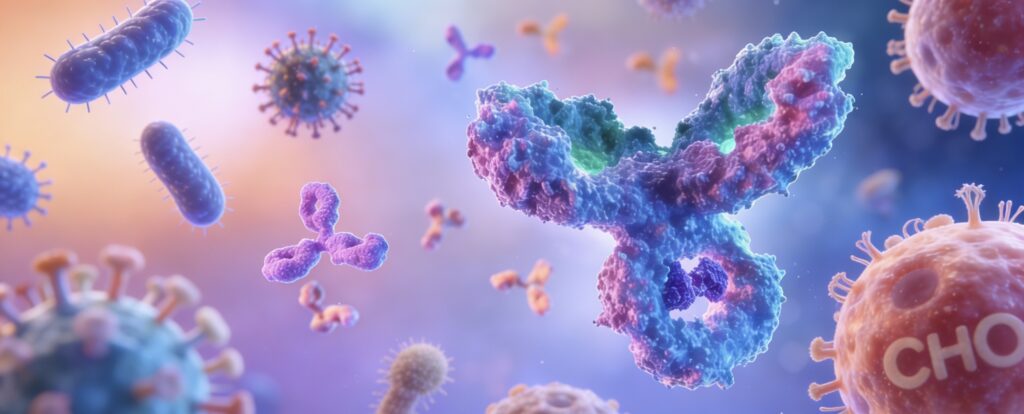
Bioss explains how expression systems can influence recombinant protein quality, activity, and suitability for downstream research.
When selecting a recombinant protein, researchers often focus first on the target, purity, concentration, or price. However, the expression system used to produce the protein can be equally important.
A recombinant protein produced in E. coli may differ substantially from the same target produced in yeast, insect cells, HEK293 cells, or CHO cells. The host system can influence protein folding, post-translational modifications, aggregation, endotoxin content, biological activity, and ultimately experimental performance.
There is therefore no universally “best” recombinant protein expression system. The better question is:
Which expression system provides the characteristics required for the intended application?
Different experiments place different demands on recombinant proteins.
For a western blot control, native biological activity or mammalian glycosylation may not be necessary. A highly pure, economical protein can often perform well.
For ELISA standards or antibody-binding studies, correct conformation and epitope accessibility become more important.
For cell-based functional assays, researchers should pay closer attention to biological activity, endotoxin, aggregation, and other potentially interfering contaminants.
Animal studies may impose even stricter requirements for endotoxin, stability, and reproducible activity, while structural studies can require highly homogeneous material with appropriate folding and post-translational modifications.
Selecting the right protein therefore begins with defining what the experiment actually requires.
Bacterial expression in Escherichia coli remains one of the most widely used approaches for recombinant protein production because it can provide high yields at relatively low cost.
It is especially useful for:
However, E. coli does not provide mammalian glycosylation. Some proteins may also form inclusion bodies and require refolding. Because bacterial systems can introduce endotoxin, endotoxin specifications should be reviewed carefully for sensitive cell-based experiments and in vivo research.
As one example, Bioss‘ Recombinant Human IL-6 Protein, C-His (BS-10807P) is produced using an E.coli expression system.
Yeast expression systems offer some advantages of eukaryotic protein production while often remaining more economical and scalable than mammalian systems.
They can support protein folding and post-translational modification that bacterial cells cannot provide. However, yeast glycosylation differs from mammalian glycosylation, which may affect the suitability of a protein when native human glycan structures are important to activity or molecular recognition.
Yeast can therefore be useful for proteins requiring eukaryotic processing when fully mammalian-type modification is not essential.
Baculovirus-based insect cell systems, including Sf9 cells, are widely used for proteins that are difficult to produce correctly in bacteria.
They can accommodate relatively large or structurally complex proteins and provide more sophisticated folding and post-translational processing than bacterial systems. Their glycosylation patterns, however, still differ from those of mammalian cells.
Typical applications include:
An example is Bioss’ Recombinant Human DLST/OGDC-E2 Protein (BS-105149P), produced using an Sf9 insect-cell expression system.
When native-like mammalian protein processing is important, HEK293 and CHO cells are two of the most commonly used expression systems.
Mammalian cells can provide complex protein folding, disulfide bond formation, phosphorylation, and glycosylation patterns that more closely resemble those occurring naturally in mammalian systems.
HEK293
HEK293 cells are widely used for research-scale recombinant protein production. Their high transfection efficiency makes them particularly useful when rapid production and human-like protein processing are priorities.
For example, Recombinant Human IL-6, Active and Tag-Free (BS-48002P) is produced in HEK293 cells.
CHO
CHO cells are extensively used in biopharmaceutical production because they are well suited to stable, scalable protein expression. They can be particularly valuable when long-term production, scalability, and lot-to-lot consistency are important considerations.
A practical distinction is therefore:
The expression host alone, however, should not determine the purchasing decision. Actual quality-control data including activity, purity, and aggregation remain critical.
Regardless of the expression system, researchers should review several key parameters before selecting a recombinant protein.
1. Endotoxin
Endotoxin can strongly influence immune cells and other sensitive biological systems. For cell-based or animal experiments, endotoxin specifications should therefore be reviewed rather than assuming that high protein purity also means low endotoxin.
2. Biological activity
A protein can be highly pure without being biologically active.
When function matters, look for an appropriate activity assay. For cytokines, growth factors, receptors, and ligands, cell-based dose-response data or EC50 values can provide much more useful information than purity alone.
3. Purity and aggregation
SDS-PAGE is useful for assessing protein purity, but it may not identify aggregates present under native conditions. For aggregation-sensitive applications, techniques such as size-exclusion chromatography can provide additional information.
For example, Bioss Recombinant Human TNFR2 Protein (BS-47216P) includes multiple forms of quality-control characterization.
4. Lot-to-lot consistency
For longitudinal studies or assay development, variation between production lots can become an important source of experimental variability. Researchers should consider both purity and functional consistency when selecting materials intended for repeated use.
5. Storage and reconstitution
Storage conditions, reconstitution buffer, carrier proteins, adsorption to tube surfaces, and repeated freeze-thaw cycles can all influence recombinant protein stability and effective working concentration.
Always review the product-specific handling recommendations before use.
Consider recombinant human TNF-α.
For use as a western blot control, an economical bacterial protein may be entirely appropriate. Recombinant Human TNF-α Protein, GST (BS-2258P) is one example.
For a functional cell-based assay, the selection criteria change. Biological activity, endotoxin, protein conformation, and other quality-control parameters become more important. A mammalian-expressed active protein such as Recombinant Human TNF-α, Active and Tag-Free (BS-48004P) may therefore be better suited to certain workflows.
The target is the same, but the experimental requirements are different.
A simple decision framework can help:
If native biological activity is not required, bacterial expression may provide an economical solution.
If activity depends on complex folding or mammalian post-translational modifications, HEK293 or CHO expression may be preferable.
If eukaryotic folding is needed but fully mammalian processing is not essential, yeast or insect cells may provide an effective middle ground.
For sensitive cell-based or in vivo studies, carefully evaluate endotoxin, biological activity, aggregation, and supporting QC data regardless of the expression host.
Ultimately, expression system should be considered alongside, not instead of, product-specific quality data.
The growing Bioss recombinant proteins portfolio spans multiple expression systems, protein formats, tags, and research applications.
By first defining what your experiment requires, you can select a recombinant protein that better fits your workflow. Whether you need an economical western blot control, an active cytokine for a cell-based assay, or a mammalian-expressed protein with specific QC data, the right expression system can help you achieve more reliable results.
Selecting the right recombinant protein is not always straightforward. Expression system, protein format, tag, endotoxin level, and QC data can all affect how well a protein fits your experiment. If you are unsure which option best matches your application, Bio-Connect is happy to think along with you. Our team supports researchers across the Benelux with product selection, alternatives, documentation, and technical questions.


Antibodies | ELISA | IHC | Recombinant Proteins | Protein Markers/ Ladders | Protease/ Phosphatase Inhibitors | Conjugations | Biosimilars
We gladly support you by keeping you updated on our latest products and developments