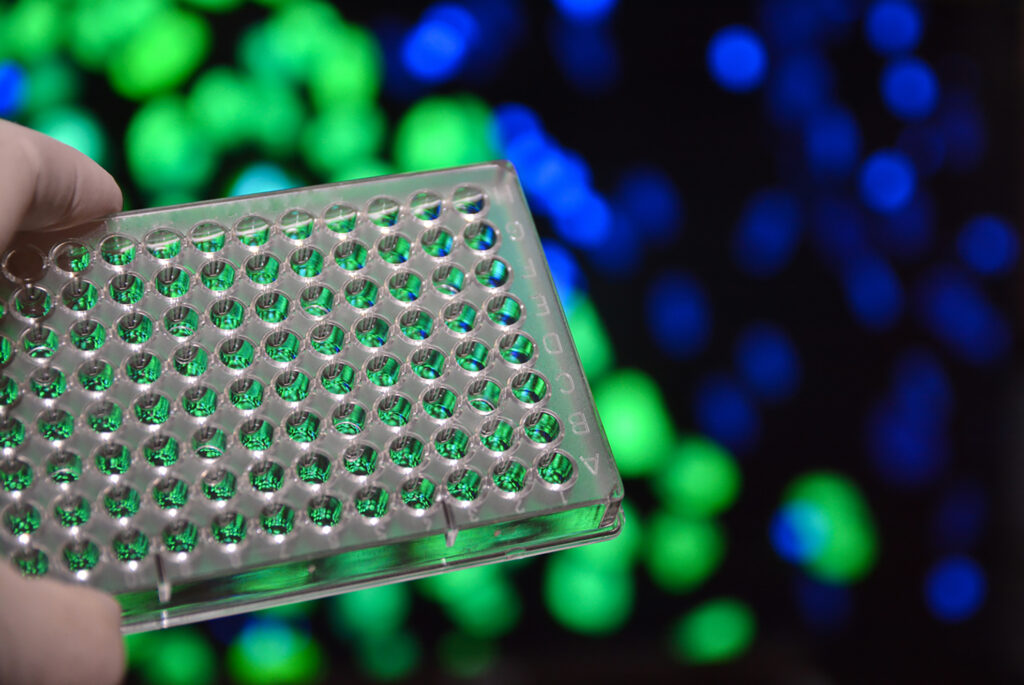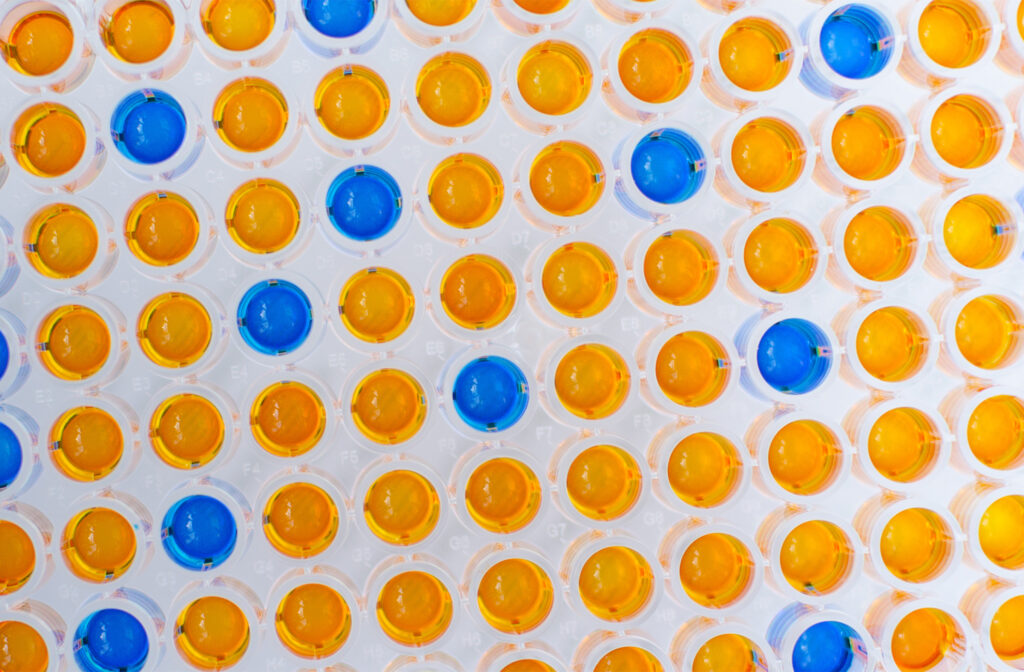
AntBio‘s OneStep HS IFN-γ ELISA kit quantifies this central Th1 cytokine down to 0.316 pg/mL in serum, plasma and culture supernatant.
Interferon-gamma (IFN-γ) is the only type II interferon and one of the most consequential readouts in cell-mediated immunity. Produced mainly by activated CD4+ Th1 cells, CD8+ cytotoxic T cells and NK cells, it signals through the IFNGR1/IFNGR2 receptor pair and the JAK1/JAK2-STAT1 axis to upregulate MHC expression, strengthen antigen presentation and drive macrophage activation. Those same pathways connect IFN-γ to tuberculosis control, graft-versus-host disease, autoimmune pathology and the response to cancer immunotherapy, which is why so many laboratories now treat IFN-γ quantification as a routine rather than an occasional measurement.
It is also a measurement that is easy to underestimate. Three properties of the analyte set the bar for any assay used to detect it.
An assay that cannot handle all three at once produces data that look plausible and fail quietly.
The clearest way to see what “validated” means in practice is to look at the specification sheet of a high-sensitivity format. The Human IFN-γ OneStep HS ELISA Kit (#S0C3055) uses a one-step double-antibody sandwich design, with the tag antibody pre-coated on the plate and the capture-detection system pre-positioned so that sample addition, a single incubation and a wash complete the assay.
One specification matters more than the rest for anyone pooling data across studies: the dose-response curve runs parallel to the international standard NIBSC 87/586, so results can be converted between mass and international units using the relationship NIBSC (87/586) approximate value (IU/mL) = 0.02 × kit value (pg/mL). That single line is what makes a result comparable across platforms, laboratories and time.
In this video, AntBio introduces its OneStep ELISA range and simplified assay workflow:
IFN-γ release assays rest entirely on accurate quantification of IFN-γ released into whole blood after mycobacterial antigen stimulation. Because different kit brands differ in repeatability, intermediate precision and accuracy when applied to QuantiFERON culture supernatants, the choice of a validated kit is itself part of the diagnostic result, not an upstream detail.
Tumour-infiltrating T cells use IFN-γ to upregulate MHC class I on tumour cells, improve antigen presentation and restrain angiogenesis. Under anti-PD-1 and anti-CTLA-4 treatment, activation of IFN-γ signalling is an important predictor of response, and measuring IFN-γ in tumour homogenate alongside peripheral blood, combined with CD8+ infiltration density, supports assessment of immunotherapy response potential.
Antigen-specific IFN-γ secretion after re-stimulation is the standard readout of a vaccine-induced Th1 response, and combining ELISA or ELISpot on PBMC supernatant with polyfunctional T-cell analysis (IFN-γ+/TNF-α+/IL-2+) gives a fuller picture of cellular immunogenicity. The same analyte underpins CAR-T potency evaluation, where IFN-γ secretion is a core functional parameter of engineered T-cell activity.
IFN-γ plays a genuinely bidirectional role in autoimmunity: it drives Th1 polarisation and inflammatory cytokine release, while also contributing to immune tolerance through IDO induction. In rheumatoid arthritis, IFN-γ response genes are upregulated in monocytes and T cells; in haemodialysis patients, IFN-γ-driven trained immunity tracks with monocyte hyper-responsiveness. Low-dose IFN-γ priming (1 ng/mL) is likewise a standard strategy for enhancing the immunomodulatory capacity of mesenchymal stem cells, where monitoring IFN-γ consumption in culture supernatant supports assessment of priming efficiency.
“IFN-γ ELISA kit” describes a family, not a product, and format selection should follow the sample matrix and the expected concentration range rather than habit. The four formats available through Bio-Connect cover the practical space:
| Cat. No. | Product | Format | Best suited to |
|---|---|---|---|
| S0C3055 | Human IFN-γ OneStep HS ELISA Kit | High-sensitivity one-step; 0.78–50 pg/mL, 0.316 pg/mL | Low-abundance samples: serum, plasma, culture supernatant |
| S0C3005 | Human IFN-γ OneStep ELISA Kit | Standard one-step sandwich | Routine quantification with a short workflow |
| S0C3025 | Human IFN-γ Broad range ELISA Kit | Broad-range sandwich | Samples with high or unpredictable IFN-γ levels |
| S0C3040 | Human IFN-γ OneStep OptiQuant ELISA Kit | Quantitative-optimised one-step | Studies requiring a defined quantitative readout |
All four resolve to live product pages, so researchers can check current pack sizes and documentation directly.
No specification sheet compensates for careless sample handling. Serum should be centrifuged within two hours of collection and protected from haemolysis and repeated freeze-thaw cycles. Cell culture supernatant needs strictly standardised collection timing, because IFN-γ continues to accumulate in vitro. On the assay side, reagent equilibration, pipetting precision and incubation conditions jointly determine whether the antigen-antibody reaction reaches completion, and cross-reactivity against IL-2, IL-4 and TNF-α should be verified during method validation rather than assumed away. Treating sample preparation and assay operation as one quality-control loop is what turns a sensitive kit into trustworthy data.
AntBio builds its immunoassay portfolio around the one-step architecture described above, alongside a conventional ELISA range of more than 2,000 targets with over 800 literature citations. Company-wide, AntBio products have been validated and cited in nearly 20,000 scientific publications across its three sub-brands: Starter for antibodies and immunological assay kits, UA-Bio for recombinant proteins and drug discovery solutions, and Absin for general reagents and other detection kits.
AntBio’s ELISA kits are available through Bio-Connect in the Benelux and across Europe. Our webshop lists the range, and your account manager can help with availability, pricing and documentation. If you’re unsure which format suits your sample matrix, our technical support team is happy to help.



ELISA Kits | Organoids | Spatial Biology | Proteomics | Drug Discovery | IVD Materials
We gladly support you by keeping you updated on our latest products and developments