Sepax Technologies demonstrates how Proteomix ion-exchange chromatography separates unconjugated antibody, AOC OAR variants and free oligonucleotide in one analysis.
Antibody-oligonucleotide conjugates (AOCs) combine the target specificity and favorable pharmacokinetic properties of antibodies with the unique biological function of oligonucleotides. This combination is opening new possibilities for targeted delivery, therapeutics, diagnostics and other emerging applications.
However, AOC synthesis can produce a complex mixture. Depending on the conjugation strategy, the final sample may contain unconjugated antibody, AOCs with different degrees of conjugation and residual free oligonucleotide. Accurately determining the degree of conjugation, commonly expressed as the Oligonucleotide-to-Antibody Ratio (OAR), is therefore important for assessing product consistency, conjugation efficiency and purification performance.
An effective analytical method must distinguish these closely related species while accommodating the different physicochemical properties of the antibody, oligonucleotide payload and linker.
Ion-exchange high-performance liquid chromatography (IEX-HPLC) provides a direct, charge-based approach to AOC characterization. Each attached oligonucleotide generally increases the overall negative charge of the conjugate. As a result, AOCs with different OAR levels interact differently with an ion-exchange stationary phase.
Strong anion-exchange (SAX) chromatography is particularly useful for exploiting these charge differences. Conjugates with higher oligonucleotide loading generally bind more strongly to the positively charged SAX stationary phase and elute later during a salt or pH gradient.
This retention mechanism makes SAX suitable for profiling AOC conjugation variants and monitoring changes in OAR during method development, production and purification.
The Proteomix IEX platform offers four important advantages for AOC characterization:
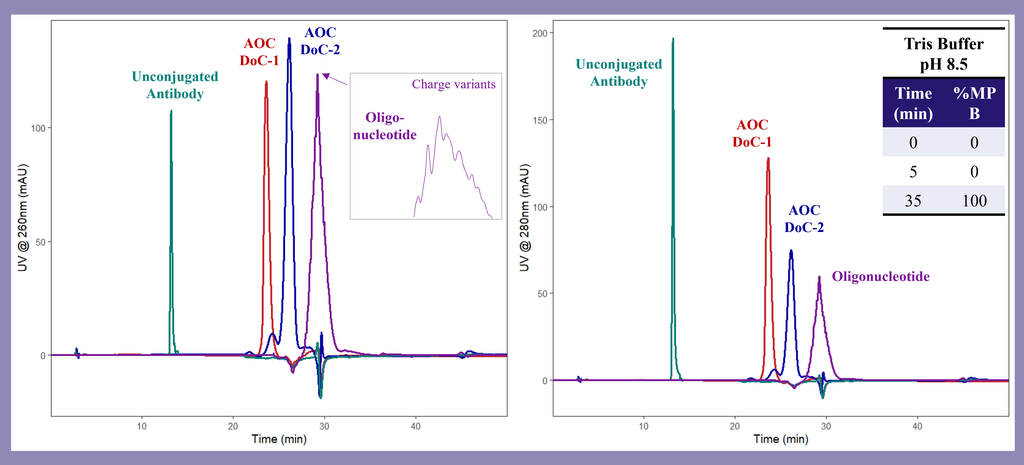
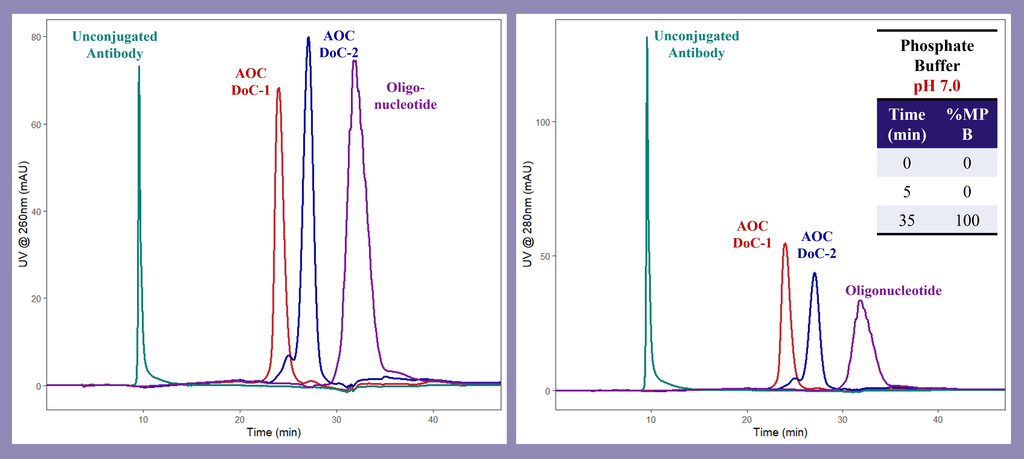
Sepax Technologies evaluated a Proteomix® SAX-NP5 column for separating an unconjugated antibody, two AOC conjugation levels and free oligonucleotide.
Under Tris buffer conditions at pH 8.5, the method provided clear retention and separation of all four sample components. The unconjugated antibody eluted first, followed by AOC OAR-1 and AOC OAR-2. The free oligonucleotide eluted last and displayed additional charge-variant peaks.
The retention order correlated well with the increasing contribution of the negatively charged oligonucleotide payload. This demonstrates how Proteomix SAX converts differences in conjugation level into distinct chromatographic profiles, enabling direct comparison of the unconjugated antibody, individual AOC variants and free oligonucleotide within a single analysis. These capabilities support both qualitative assessment of sample heterogeneity and quantitative OAR analysis.
For researchers developing or optimizing an AOC, this profile helps answer practical questions:
AOC stability reflects the combined behavior of the antibody, oligonucleotide and linker. Although strongly basic conditions may improve SAX retention for some samples, prolonged exposure can affect antibody structure, linker stability or sensitive RNA-based payloads.
To expand method flexibility, Sepax combined Proteomix SCX and SAX columns in tandem. The two stationary phases provide complementary charge-based interactions. The SCX segment provides interaction with positive charge domains on the antibody component, while the SAX segment strengthens retention as the negative-charge contribution from the oligonucleotide increases.
The tandem method therefore complements the strong performance of standalone SAX: Proteomix SAX provides effective separation of the complete AOC mixture, while SCX + SAX extends the platform to AOCs requiring milder analytical conditions.
Proteomix IEX can support AOC development from initial conjugation studies through purification optimization and product characterization. Potential applications include:
By resolving the major components of an AOC mixture, the method provides actionable information for optimizing reaction conditions, selecting purification strategies and monitoring changes throughout development.
Reliable AOC characterization requires more than detecting the conjugated product. Separating the unconjugated antibody, individual conjugation levels and free oligonucleotide provides deeper insight into conjugation efficiency, product heterogeneity and downstream purification.
Proteomix SAX provides a direct, high-resolution approach for separating unconjugated antibody, AOC conjugation variants and free oligonucleotide in a single analytical run.
Download the complete Sepax AOC application note to review the chromatograms, column configurations and experimental conditions.
Need help selecting an IEX column or developing a method for your AOC? Contact your Bio-Connect account manager or our technical support team to explore the most suitable Proteomix IEX column and method-development strategy for your sample.


HPLC Columns | Chromatography Resins | SEC Columns | Affinity Media | Purification Services | OEM/ODM Services
We gladly support you by keeping you updated on our latest products and developments