AAVs are useful for gene therapy due to their efficiency and safety. They are also the best vector for in vivo experiments. BPS Bioscience has developed a portfolio of AAV products to support your research needs.
Adeno-associated virus (AAV) is a small, non-enveloped virus composed of an icosahedral capsid that encloses a short, single-stranded DNA genome flanked by two ITR (inverted terminal repeats). AAVs are replication-defective, do not normally integrate into the host genome, and are non-pathogenic, and have become widely used tools for gene delivery in the treatment of genetic diseases.
Owing to their low immunogenicity and lack of insertional mutagenesis, AAVs are considered safe for clinical use and are the vector of choice for many gene therapies currently in development. They are also among the most effective vectors for transducing genes of interest in animal models.
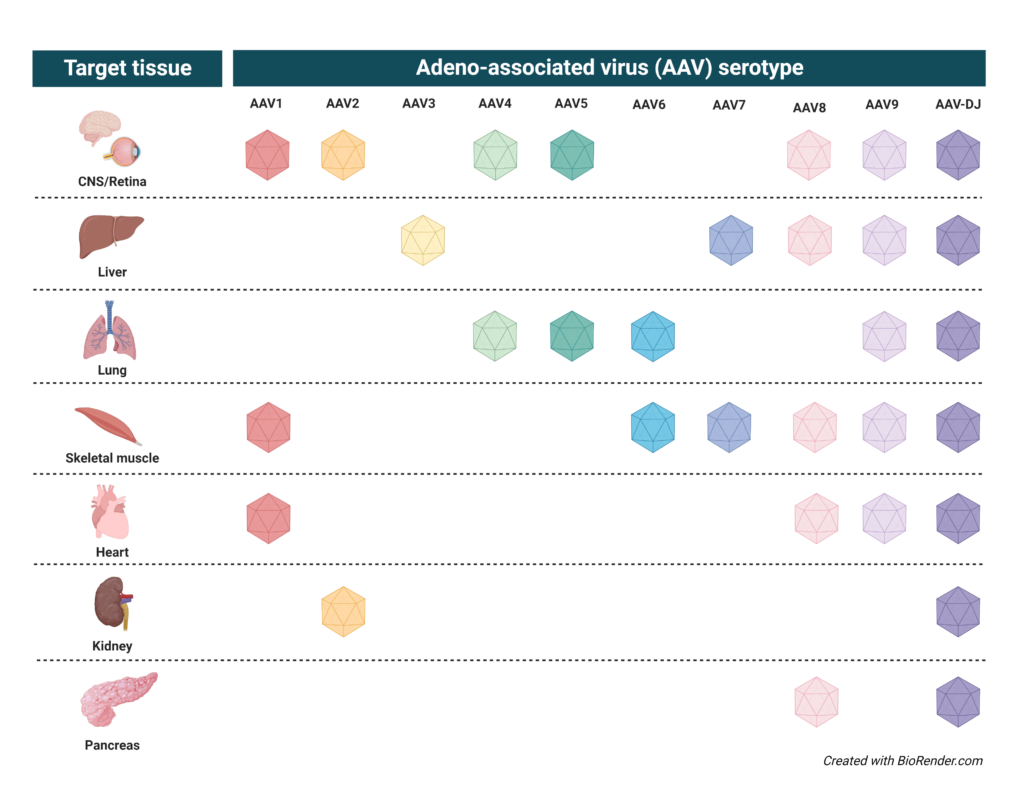
AAV serotypes exhibit preferential binding to specific cell types and tissues, a property determined by the affinity of capsid proteins for cell surface receptors and glycans. Researchers exploit this natural tropism to target defined cell populations. In addition, engineered AAV variants have been developed to further enhance tissue tropism and transduction efficiency for gene therapy applications. One example is AAV-DJ, which demonstrates improved transduction efficiency both in vitro and in vivo compared with wild-type serotypes, enabling infection of a broad range of cell types.
Recombinant AAVs used for gene therapy are engineered to deliver a transgene of interest in place of the viral genome. On the other hand, the insert size is limited to a maximum of about 5 kb. These vectors commonly contain AAV2 ITRs, a mammalian promoter, and a transcriptional terminator. Frequently used promoters include CMV (cytomegalovirus), EF1α (elongation factor 1α), and SV40 (simian virus 40). The use of tissue-specific promoters, such as the enolase promoter for neuron-specific expression, can further restrict transgene expression to defined cell types.
Following cellular entry, recombinant AAV genomes are maintained as episomes and can support sustained transgene expression for up to six months in non-dividing and differentiated tissues, including the brain, retina, liver, skeletal muscle, and heart.
BPS Bioscience portfolio of AAV products, including AAV-DJ products, was developed to support various research needs.
Reporter proteins such as luciferase or fluorescent markers are ideal to visualize and/or quantify gene expression following AAV transduction. Luciferase, ZsGreen, and mCherry-containing AAVs can be used as internal controls, to optimize transduction and experimental conditions, track transgene expression over time, and monitor AAV transduction in vivo.
Our AAV2 ZsGreen (#78444) expresses ZsGreen under a CMV promoter. ZsGreen is a human codon-optimized variant of the green fluorescent protein isolated from Zoanthus sp. It is engineered for high expression in mammalian cells and is up to 4 times brighter than enhanced green fluorescent protein (eGFP). Users can visually assess viral transduction efficiency via fluorescence microscopy or flow cytometry. ZsGreen has an excitation wavelength of 493nm and an emission wavelength of 505nm. We offer other AAV serotypes which express ZsGreen , as well as other fluorescent proteins such as eGFP and mCherry. We also offer several serotypes expressing the firefly (Photinus pyralis) luciferase gene under the control of a CMV promoter allowing transduction efficiency to be verified by measuring luciferase activity (example: AAV8 Luciferase #78458).
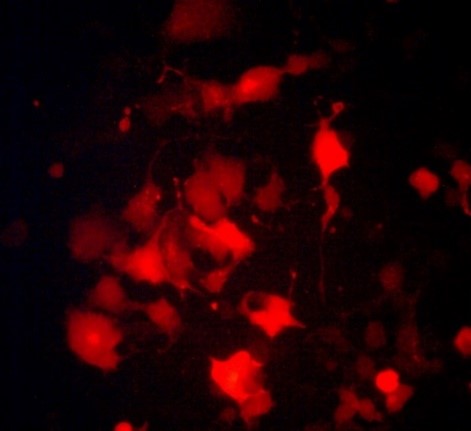
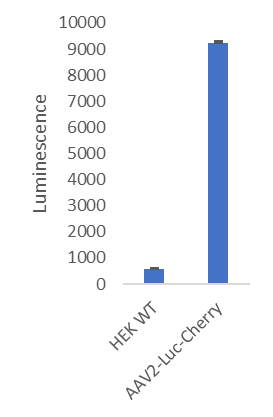
mCherry fluorescence and luciferase activity in HEK293 cells transduced by AAV2 Luciferase-mCherry particles (#78471). HEK 293 cells were transduced with AAV2 Luciferase-mCherry at an MOI of 2 x 10⁴. After 72 hours of transduction, mCherry expression was assessed by fluorescent microscopy (left panel) and luciferase activity was measured using the ONE-Step™ Luciferase Assay System (#60690) using non-transduced HEK293 cells as control (right panel).
CRISPR-associated protein 9 (Cas9) is an endonuclease enzyme that causes double-stranded breaks in DNA and allows the genome to be modified after introducing a guide RNA corresponding to the region of interest within the gene. AAV SaCas9 vectors transduce an HA-tagged SaCas9 (Staphylococcus aureus CRISPR associated protein 9), which has high efficiency in mammalian cells. Its small size makes it ideal for packaging into AAV while the HA tag enables detection of the expressed protein. These vectors are used to express SaCas9 in cells and facilitate knock-out or knock-in engineering.
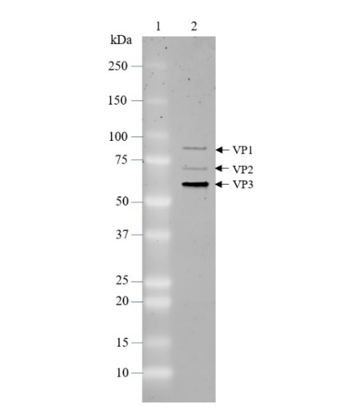
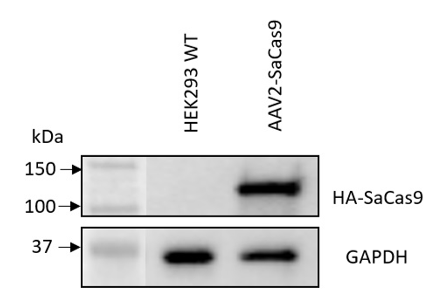
Quality control results for AAV2 SaCas9 (#78480). AAV2 SaCas9 particles were analyzed by SDS-PAGE and confirmed to be 90% pure of contaminants (left panel). Expression of SaCas9 in HEK293 cells transduced with AAV2 SaCas9 was verified by Western Blot. GAPDH was used as loading control (right panel).
When injecting AAV particles into animals, it is necessary to use highly purified particles with minimal amounts of host cell proteins. The AAV ONE-Extract™ Solution (#78585) provides a simple and efficient method for particle isolation and is suitable for all AAV serotypes, enabling improved performance over conventional freeze-thaw or sonication methods for isolation from production cells.
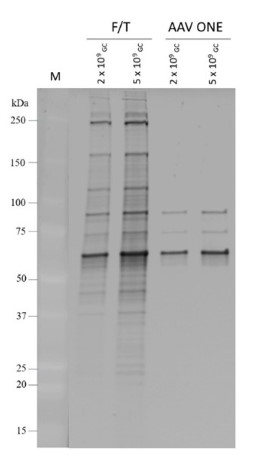
Crude AAV2 particles from AAV producing cells were extracted using the freeze-thaw method or the AAV ONE Extract Solution. The crude AAV2 particles were then purified by iodixanol discontinuous gradient ultracentrifugation, the equivalent of 2 x 10⁹ VG (viral genome) and 5 x 10⁹ VG were analyzed by SDS-PAGE to evaluate the amount of protein impurity. M: Molecular standard, F/T: Freeze-Thaw method, AAV ONE: AAV ONE Extract.
The AAV qPCR Titration Kit (#82812) accurately measures AAV titers for particles containing AAV2-ITRs using qPCR (quantitative polymerase chain reaction). It offers a streamlined, one-step process and displays high sensitivity and specificity, minimizing non-specific background. The kit includes the ROX (carboxyrhodamine) passive fluorescence reference dye that allows for signal normalization, and an AAV standard for precise quantification. It has been validated across multiple AAV samples with varying serotypes, purification status, and encapsulated transgenes, consistently demonstrating accuracy, precision, and robustness.
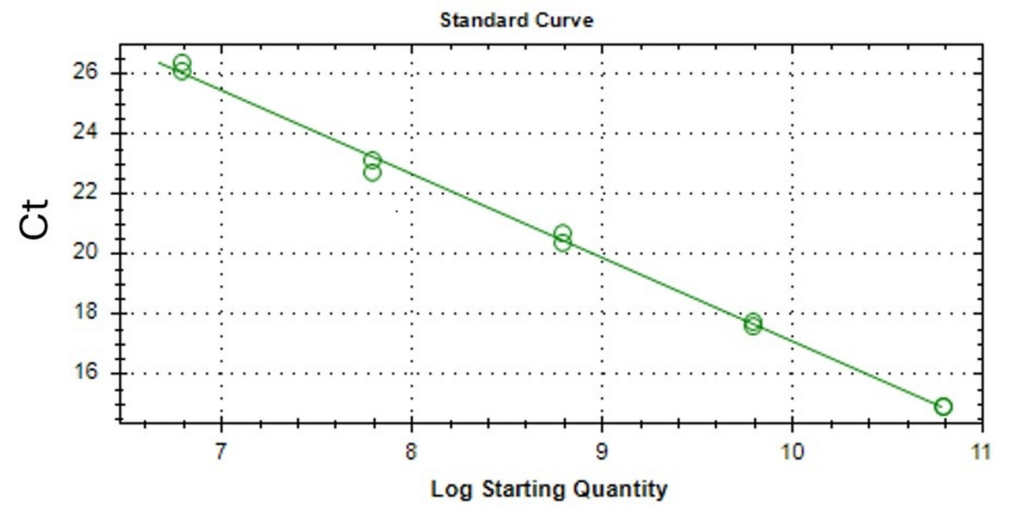
Standard curve generated with the AAV Reference using the AAV qPCR Titration Kit (#82812).
| Catalog # | Name |
| 78585 | AAV ONE-Extract™ Solution |
| 82092 | AAV-DJ Anti-CD19 CAR (CD19 ScFv-CD8-4-1BB-CD3ζ) |
| 78451 | AAV-DJ Luciferase |
| 78460 | AAV-DJ Luciferase-eGFP |
| 78469 | AAV-DJ Luciferase-mCherry |
| 82112 | AAV-DJ MBP eGFP |
| 82135 | AAV-DJ SP-B-Luciferase |
| 82134 | AAV-DJ SYN1-Luciferase |
| 78478 | AAV-DJ SaCas9 |
| 78871 | AAV-DJ Scrambled shRNA Control |
| 82137 | AAV-DJ TERT-Luciferase |
| 78442 | AAV-DJ ZsGreen |
| 82253 | AAV-DJ-CMV-mCherry |
| 78452 | AAV1 Luciferase |
| 78461 | AAV1 Luciferase-eGFP |
| 78470 | AAV1 Luciferase-mCherry |
| 78479 | AAV1 SaCas9 |
| 78443 | AAV1 ZsGreen |
| 78453 | AAV2 Luciferase |
| 78462 | AAV2 Luciferase-eGFP |
| 78471 | AAV2 Luciferase-mCherry |
| 78480 | AAV2 SaCas9 |
| 78444 | AAV2 ZsGreen |
| 78454 | AAV3 Luciferase |
| 78463 | AAV3 Luciferase-eGFP |
| 78472 | AAV3 Luciferase-mCherry |
| 78481 | AAV3 SaCas9 |
| 78445 | AAV3 ZsGreen |
| 78446 | AAV4 ZsGreen |
| 78456 | AAV5 Luciferase |
| 78465 | AAV5 Luciferase-eGFP |
| 78474 | AAV5 Luciferase-mCherry |
| 78483 | AAV5 SaCas9 |
| 78447 | AAV5 ZsGreen |
| 82093 | AAV6 Anti-CD19 CAR (CD19 ScFv-CD8-4-1BB-CD3ζ) |
| 78457 | AAV6 Luciferase |
| 78466 | AAV6 Luciferase-eGFP |
| 78475 | AAV6 Luciferase-mCherry |
| 78484 | AAV6 SaCas9 |
| 78448 | AAV6 ZsGreen |
| 78458 | AAV8 Luciferase |
| 78467 | AAV8 Luciferase-eGFP |
| 78476 | AAV8 Luciferase-mCherry |
| 78485 | AAV8 SaCas9 |
| 78449 | AAV8 ZsGreen |
| 78459 | AAV9 Luciferase |
| 78468 | AAV9 Luciferase-eGFP |
| 78477 | AAV9 Luciferase-mCherry |
| 78486 | AAV9 SaCas9 |
| 78450 | AAV9 ZsGreen |
Our off-the-shelf products exemplify BPS Bioscience’s capability and expertise and can easily be applied to the development of custom AAV particles expressing any protein of interest. The challenges associated with AAV design and production can be left in our hands, saving researchers time and costs. Applications include CRISPR-mediated genetic engineering, protein expression, the design and optimization of AAV-mediated gene transfer using reporter AAVs, and shRNA transducing AAVs. Talk to your Bio-Connect distributor for deliverables:
Contact your account manager for more info on BPS Bioscience AAV services.


Proteins & enzymes | Antibodies | Lentiviruses | Cell Lines | Biochemical and Cellular Assay Kits
We gladly support you by keeping you updated on our latest products and developments