
How can cartilage breakdown be tracked and do why sample type matter? Human Cartialge Oligomeric Matrix Protein ELISA from BioVendor offers answers to these questions.
Cartilage Oligomeric Matrix Protein (COMP) from BioVendor is a non-collagenous extracellular matrix protein found primarily in hyaline cartilage, but also in tendons, ligaments, and menisci. It plays a key role in the structural stability of cartilage, where it binds to collagen and other matrix proteins, contributing to the mechanical strength and elasticity of joints. Under physiological conditions, COMP is mainly located in cartilage; however, during tissue degradation it is released into synovial fluid and subsequently into the bloodstream, where it can be quantified using sensitive laboratory methods.
Measurement of serum COMP levels serves as a biomarker of cartilage degradation and is mainly used in the diagnosis and monitoring of musculoskeletal disorders. Elevated COMP levels reflect cartilage damage and disease activity.
COMP testing is particularly useful in:
In osteoarthritis, progressive degeneration of joint cartilage occurs. Elevated COMP levels may:
In rheumatoid arthritis, COMP serves as a marker of:
Elevated levels may be detected even in early stages of the disease.
Increased COMP levels have also been reported in:
Therefore, COMP testing may help in early detection of cartilage damage and in assessing long-term risk of degenerative changes.
COMP testing is therefore a valuable tool in rheumatology, orthopedics, and sports medicine.
The selection of the correct sample type -serum or synovial fluid- is essential for obtaining meaningful results. Serum values reflect the overall condition, while synovial fluid is used for monitoring treatment of an individual joint.
COMP levels in synovial fluid were found to be twofold higher within 6 weeks after Anterior Cruciate Ligament injury and remained elevated for up to 5 years, while serum COMP stayed unchanged throughout (based on exploratory analysis in KANON trial*).
*Struglics A, Larsson S, Pramhed A, Frobell R, Swärd P. Changes in synovial fluid and serum concentrations of cartilage oligomeric matrix protein over 5 years a_er anterior cruciate ligament rupture: an exploratory analysis in the KANON trial. Osteoarthritis Cartilage. 2018 Oct;26(10):1351-1358. doi: 10.1016/j.joca.2018.06.005. Epub 2018 Jun 26. PMID: 29958916.
To capture early cartilage changes and monitor disease progression, synovial fluid COMP may provide higher sensitivity than serum measurements. Determination of COMP in synovial fluid provides higher joint specificity and greater sensitivity to local cartilage damage, making it more suitable for personalized or sports medicine. Serum is a non-invasive sample type that is easy to collect, suitable for longitudinal monitoring, widely applicable in clinical practice, and more standardized.
| Product Name | Catalog No. | Size | Regulatory Status |
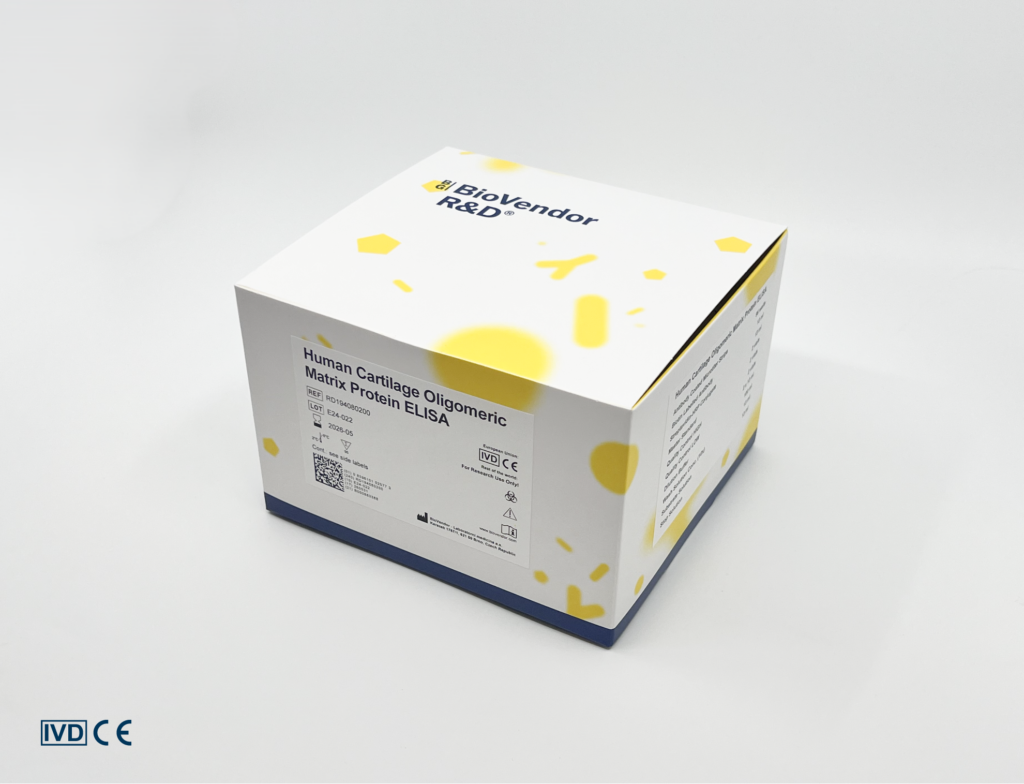
| Human Cartilage Oligomeric Matrix Protein ELISA | RD194080200 | 96 wells | CE IVD |
Bio-Connect offers the Human Cartilage Oligomeric Matrix Protein ELISA (RD194080200) from BioVendor in our webshop. Visit the product page for a clear overview of the assay, performance data, and pricing, and to place your order directly online.
Would you like personal advice or do you have any questions? Feel free to contact us via the contact page or get in touch with your Bio-Connect account manager. We are happy to think along with you.



ELISA | Proteins | Antibodies | IVD | endotoxin testing | POCT CE/IVD
We gladly support you by keeping you updated on our latest products and developments