 Direct contact technical support
 Find products for your research
Unlock new possibilities in SNP detection with the SolisAcuraTM
If you’re looking to streamline SNP detection with accuracy, flexibility, and reliability, Solis BioDyne’s new SolisAcura™ product family delivers exactly that.
Solis BioDyne’s SolisAcura™ polymerase supports allele-specific PCR assays used for SNP genotyping in agriculture. Learn how optimized enzymes improve accuracy and throughput in crop genetics.
Modern agriculture increasingly relies on genetic information to accelerate crop improvement. Plant breeders routinely screen thousands of samples to identify genetic variants associated with desirable traits such as yield, disease resistance, drought tolerance, and quality characteristics.
One of the most widely used technologies for this purpose is allele-specific PCR, a reliable and cost-efficient method for detecting single nucleotide polymorphisms (SNPs). In high-throughput breeding programs, this technique enables rapid genotyping of large plant populations, supporting marker-assisted selection and trait validation.
Single nucleotide polymorphisms (SNPs) are the most common form of genetic variation in plants and animals. Identifying these small DNA differences allows researchers and breeders to:
Because agricultural programs often analyze thousands of samples, genotyping technologies must be both accurate and scalable.
Allele-specific PCR assays have become a cornerstone technology for these workflows due to their flexibility, cost efficiency, and compatibility with high-throughput systems.
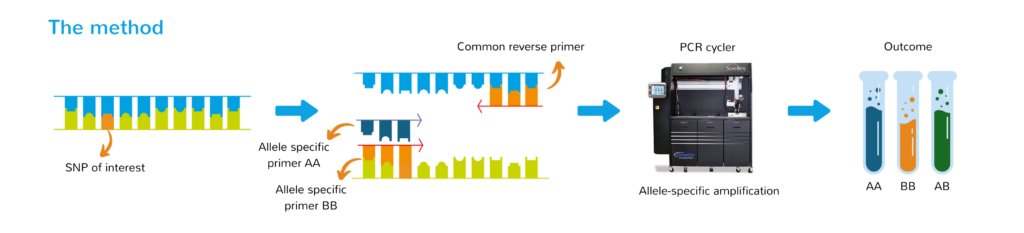
Allele-specific PCR relies on a simple principle: PCR primers can be designed so that amplification occurs only when they perfectly match a specific DNA variant (Figure 1). In these assays, two competing primers target the same SNP position, each corresponding to a different allele.
During PCR, the primer that matches the DNA template binds efficiently and produces amplification, while the mismatched primer does not. This allows researchers to determine the genotype of each sample.
When combined with real-time PCR instruments or other high-throughput systems, the method enables rapid analysis of large breeding populations, making it well-suited for modern agricultural genotyping workflows.
While the assay design is important, the success of allele-specific PCR ultimately depends on the DNA polymerase used in the reaction. The enzyme must be able to distinguish even a single mismatched nucleotide at the 3′ end of a primer while still amplifying DNA efficiently across thousands of reactions.
SolisAcura™ is a genetically engineered DNA polymerase developed specifically for allele-specific genotyping assays. Designed using in-silico approaches, the enzyme has been optimized for strong mismatch discrimination and accurate SNP detection.
Compared with conventional Taq polymerase, SolisAcura™ offers 10–15 times higher fidelity, helping ensure reliable amplification during genotyping workflows.
Agricultural genotyping rarely happens under ideal laboratory conditions. Plant samples often contain PCR inhibitors, and DNA quality can vary depending on extraction methods or sample storage.
SolisAcura™ polymerase was engineered with these challenges in mind. The enzyme performs reliably even with crude extracts and variable DNA quality, helping maintain consistent results across large sample sets. A chemical hot-start mechanism further improves specificity by minimizing non-specific amplification and primer-dimer formation.
Another practical advantage is its room-temperature stability. Using Solis BioDyne’s Stability TAG™ technology, the enzyme remains stable without cold storage, simplifying shipping and allowing reaction setup directly at room temperature.
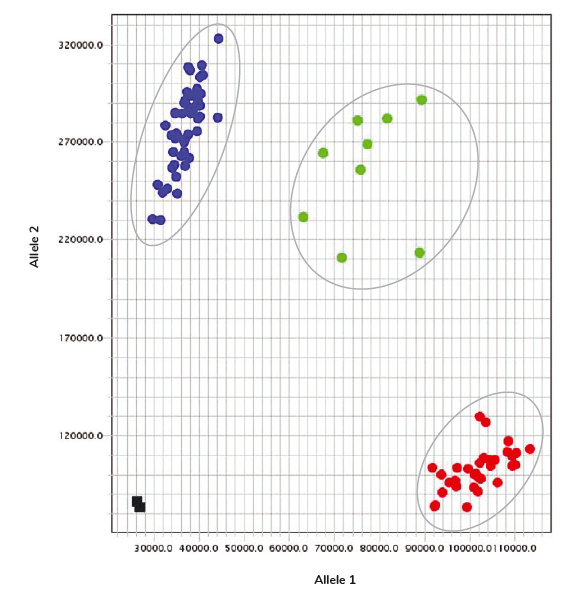
In practice, these properties translate into robust genotyping performance. Benchmarking experiments across important crops such as maize, oat, and tomato have demonstrated high genotype call accuracy and clear separation between allele clusters (Figure 2).
Such performance is particularly valuable in agricultural research, where large breeding populations and variable sample quality are common challenges.
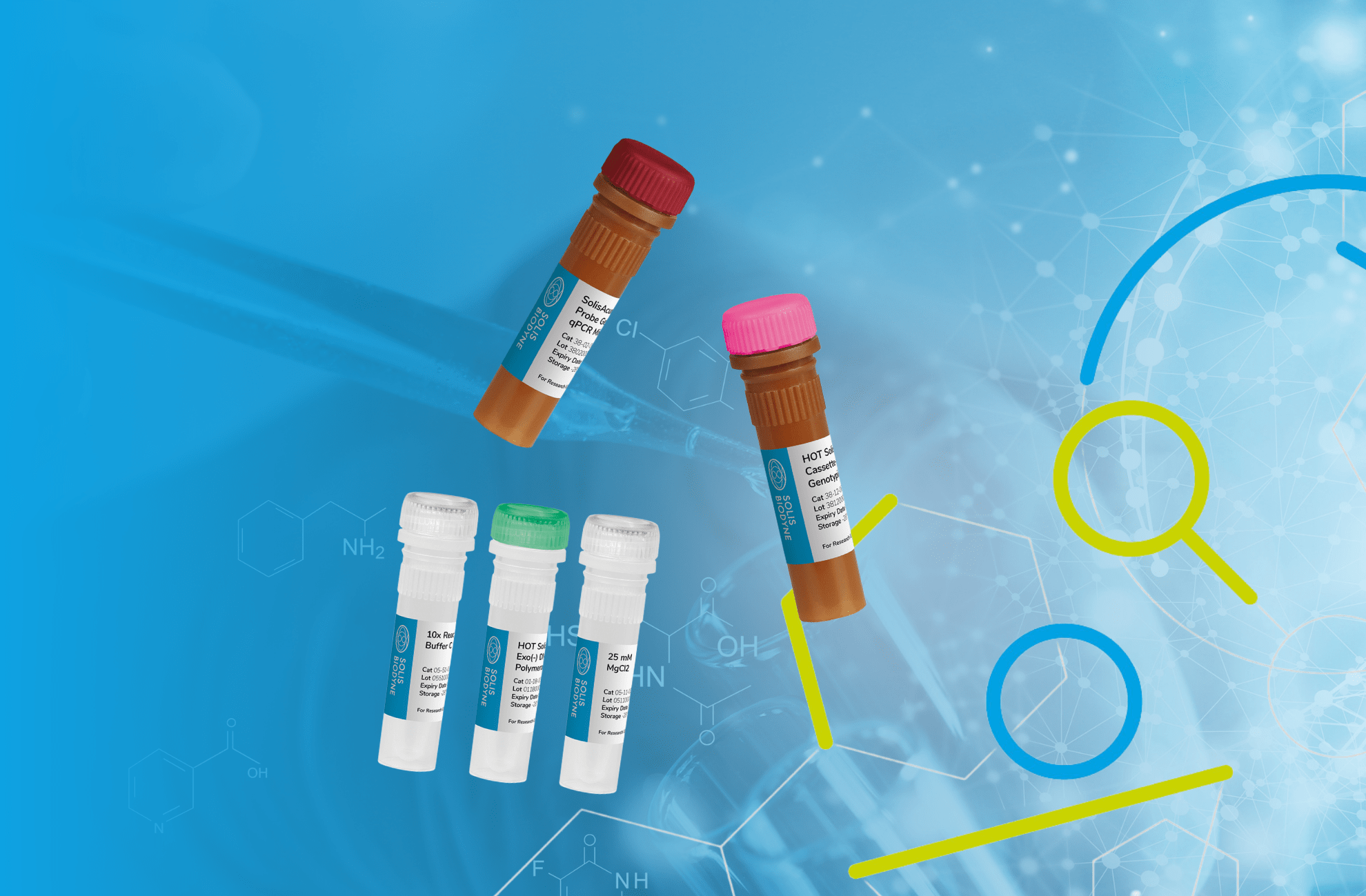
SolisAcura™ technology is available in several PCR mixes designed for SNP genotyping assays. These include both probe-based and cassette-based detection systems.
Importantly, the mixes are compatible with widely used marker chemistries such as KASP™, PACE®, and Amplifluor®, allowing laboratories to integrate the polymerase into existing genotyping workflows without redesigning assays.
Find out more from the SolisAcura™ introduction video:
Interested in finding out if the new SolisAcura™ products are a good fit for your agricultural SNP genotyping workflows? Contact your account manager to discuss the options.

We gladly support you by keeping you updated on our latest products and the developments around our services.