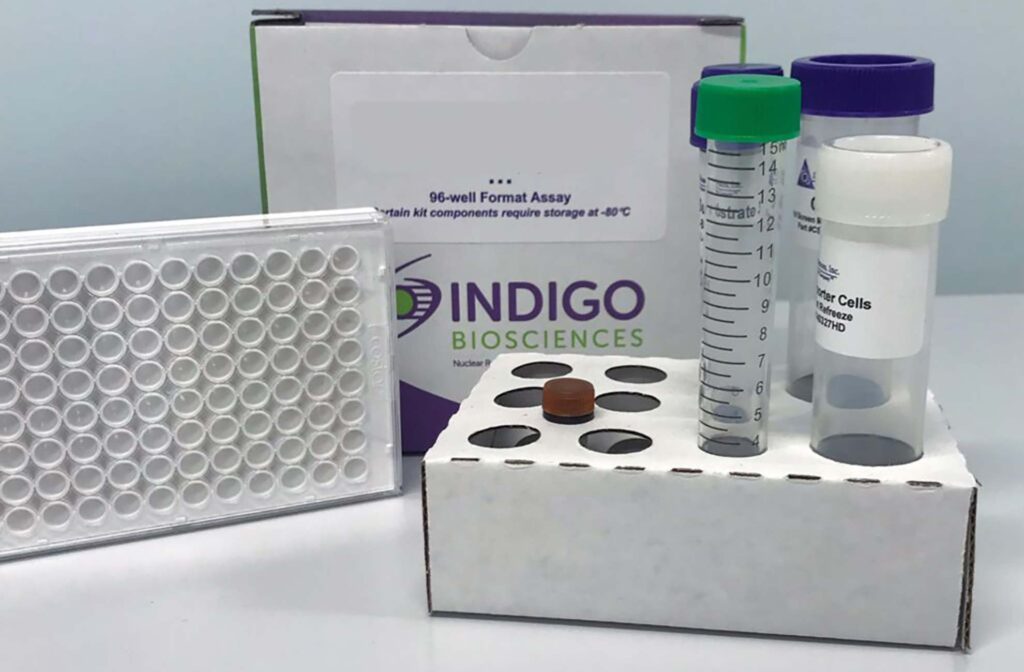
INDIGO Biosciences supports metabolic disease research beyond GLP-1R with cell-based assays targeting complementary pathways involved in metabolic regulation.
While GLP-1 receptor agonists have transformed obesity and type 2 diabetes treatment, current drug discovery increasingly requires insight into the broader signaling landscape that shapes metabolic homeostasis. INDIGO Biosciences offers a comprehensive panel of cell-based reporter assays to interrogate key nuclear receptors, GPCRs, growth factor receptors, cytokine pathways, and transcription factors involved in metabolic regulation.
GLP-1R has emerged as a central target in metabolic disease research, particularly in the development of therapies for obesity and type 2 diabetes. However, metabolic regulation involves a broader network of pathways beyond GLP-1R signaling. Investigating these additional targets is important for understanding disease mechanisms, identifying complementary biology, and characterizing compound activity across multiple pathways.
INDIGO Biosciences supports the study of metabolic regulation across multiple signaling classes, including nuclear receptors, G protein-coupled receptors (GPCRs), growth factor pathways, cytokine receptors, and transcription factors. INDIGO’s assay portfolio includes a wide variety of targets built on a unified luciferase reporter platform, enabling consistent evaluation across pathways.
Representative metabolic disease–relevant targets across these receptor classes include:
| IB0011 | Human PPARα Reporter Assay Kit |
| IB0010 | Human PPARγ Reporter Assay Kit |
| IB0012 | Human PPARδ (β) Reporter Assay Kit |
| IB3600 | Human HNF4α Reporter Assay Kit |
| IB0060 | Human FXR (NR1H4) Reporter Assay Kit |
| IB0031 | Human LXRα (NR1H3) Reporter Assay Kit |
| IB0030 | Human LXRβ (NR1H2) Reporter Assay Kit |
| IB3310 | Human GLP-1R Reporter Assay Kit |
| IB3810 | Human GIPR Reporter Assay Kit |
| IB4500 | Human GCGR Reporter Assay Kit |
| IB2800 | Human Insulin Receptor (INSRβ) Reporter Assay Kit |
| IB2900 | Human IGF-1R Reporter Assay Kit |
| IB1400 | Human GHR (Growth Hormone Receptor) Assay Kit |
| IB4900 | Human PrRPR (GPR10) Reporter Assay Kit |
| IB2600 | Human TGR5 (GPBAR1) Reporter Assay Kit |
These targets include interconnected components of metabolic regulation. Nuclear receptors such as the PPARs, FXR, LXR, and HNF4α are commonly used to study transcriptional control of lipid metabolism, cholesterol homeostasis, and hepatic gene expression. GPCR targets including GLP-1R, GIPR, GCGR, and TGR5 support investigation of endocrine signaling and bile acid–mediated metabolic regulation. Emerging GPCR targets such as PrRPR (GPR10) contribute to studies of appetite and energy balance.
Growth factor receptor assays, including insulin receptor (INSRβ), IGF-1R, and GHR, provide a complementary perspective on glucose homeostasis, growth signaling, and metabolic regulation. In addition, cytokine receptor assays such as GM-CSFR and G-CSFR (available within the INDIGO portfolio) support investigation of signaling pathways that can influence metabolic inflammation and systemic physiology.
A common application of these assays is compound characterization across multiple targets. Rather than evaluating compounds against a single receptor, researchers can assess activity profiles across nuclear receptors, GPCRs, and growth factor-responsive pathways to better understand selectivity, pathway interactions, and potential synergistic effects. This type of profiling is increasingly relevant as multi-target and pathway-modulating strategies continue to emerge in metabolic disease research.
INDIGO’s assays use a firefly luciferase reporter system, where receptor activation directly drives reporter gene expression, enabling sensitive and quantitative measurement of biological activity. Reporter cells are cryopreserved using INDIGO’s CryoMite™ process, allowing experiments to be initiated without extended cell culture while achieving reproducibility across experiments.
INDIGO’s assays are compatible with both targeted experiments and higher-throughput screening formats, enabling researchers to generate comparable data across multiple pathways within the same experimental framework. In addition to receptor assays, INDIGO’s portfolio includes transcription factor assays (e.g., NF-κB, Nrf2, p53), CYP induction, and hepatotoxicity assays, further supporting integrated study of metabolic and cellular responses.
By supporting parallel interrogation of multiple signaling pathways and continuing to expand the range of available targets, INDIGO Biosciences’ cell-based assays provide a practical approach for studying complex metabolic networks and evaluating compounds in a multi-target context relevant to current therapeutic strategies.
These cell based assays provide a practical framework for studying complex metabolic networks and evaluating compounds in a multi target context in metabolic disease research.
For a clear overview of the available metabolic pathway assays, please visit the Bio Connect webshop.
If you have any questions or need support with assay selection or experimental setup, please contact your Bio-Connect account manager or Technical Support. They will be happy to assist you.



Cell-Based Luciferase Reporter Assays | Reporter Cell Lines | Growth Factor Receptors | Cytokine Receptors | GPCRs | CYP450 | Receptor Tyrosine Kinases | Nuclear Receptors | Orthologs | Drug Repurposing | Polypharmacology | Environmental Toxicology
We gladly support you by keeping you updated on our latest products and developments