Sepax Technologies integrates complementary HPLC separation modes to characterize size, charge and hydrophobicity heterogeneity in bispecific antibodies, including mispaired species.
Bispecific antibodies (BsAbs) present analytical challenges arising from their diverse molecular architectures, chain-pairing requirements and physicochemical properties. Product-related species may include aggregates, fragments and incorrectly assembled molecules, alongside variants associated with chemical or post-translational modifications. Characterizing heterogeneities requires complementary methods with distinct separation selectivities.
Sepax Technologies established an HPLC platform comprising size-exclusion chromatography (SEC), mixed-mode SEC, ion-exchange chromatography (IEX), hydrophobic interaction chromatography (HIC) and Protein A affinity chromatography. Two structurally distinct molecules, IBI363, a PD-1/IL-2α-bias bispecific antibody fusion protein, and KN026, an anti-HER2 bispecific antibody, were chosen as representative samples.
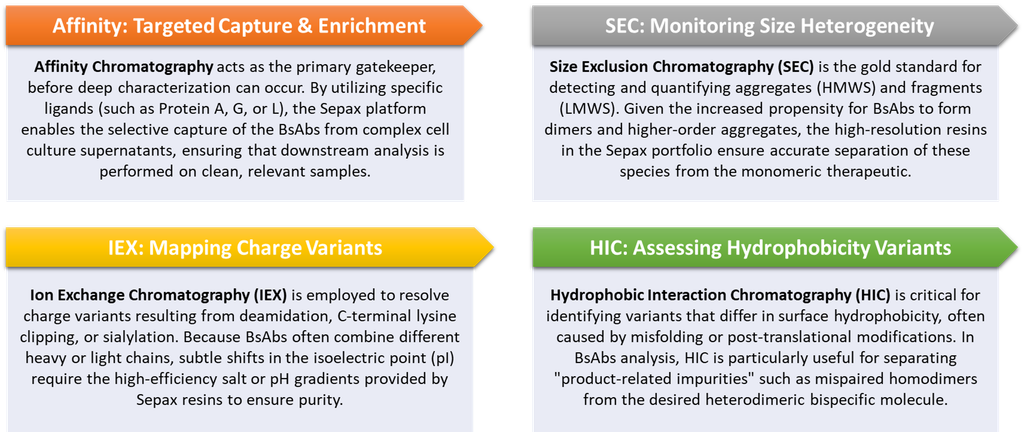
By combining chromatographic methods that probe distinct molecular properties, this strategy provides a clearer view of bispecific antibody quality through complementary assessment of product heterogeneity, supporting informed decisions during candidate screening and process development.
The results illustrate how complementary stationary phases can support multi-attribute characterization while allowing method optimization for individual BsAb formats.
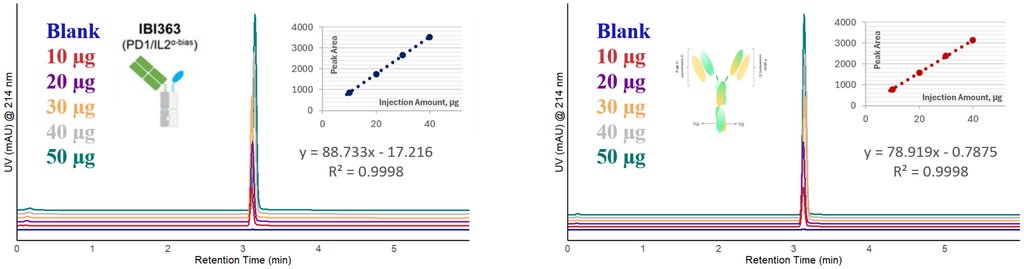
Protein A affinity chromatography adds a selective assay for compatible Fc-containing molecules. Sepax ProAqa Excel incorporates a recombinant Protein A ligand on rigid, nonporous polymer particles, supporting analysis at fast flow rates.
Both BsAbs exhibited linear responses over injected amounts of 10-50 µg on a 2.1 × 30 mm Sepax ProAqa Excel column. These results support assay development for antibody titer measurements during cell-line screening and upstream process optimization.
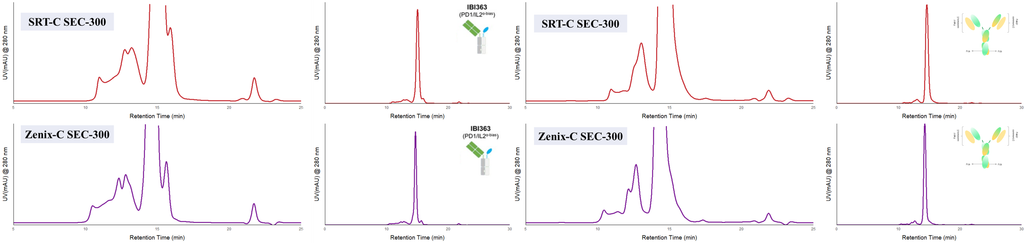
SEC separates proteins primarily according to hydrodynamic size and is widely used to assess high- and low-molecular-weight species. Separation efficiency and control of nonspecific interactions are particularly relevant for BsAbs, whose structural diversity can influence chromatographic behavior.
Sepax SRT-C 300 Å and Zenix-C 300 Å columns provided effective separation of aggregates for both BsAb candidates. The 3 µm Zenix phase offered higher analytical resolution in the reported comparison, while the 5 µm SRT phase is better suited to scale-up for semi-preparative and preparative purification.
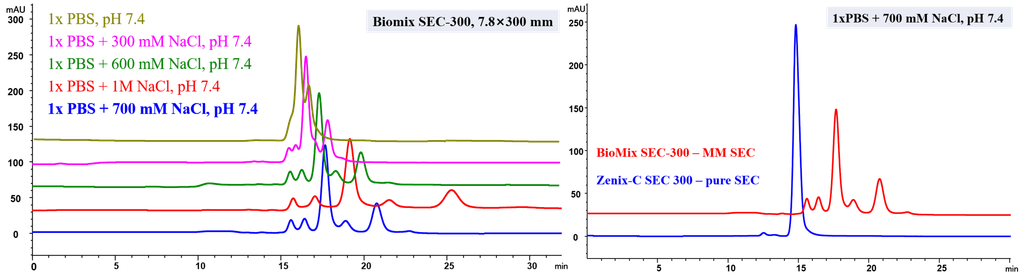
Mispaired species can be difficult to distinguish by conventional SEC when their hydrodynamic sizes closely resemble those of the intended BsAb. Introducing an additional interaction mechanism can improve discrimination between these structurally related populations.
Sepax BioMix SEC-300 extended the analysis beyond conventional size selectivity. By combining hydrophobic interactions with size-exclusion effects, the mixed-mode column demonstrated effective selectivity for separating mispaired species after method optimization.
Optimizing mobile-phase ionic strength on BioMix SEC-300 enhanced the separation of mispaired species relative to conventional SEC. This additional selectivity extends the analytical information obtainable within an SEC-based workflow.
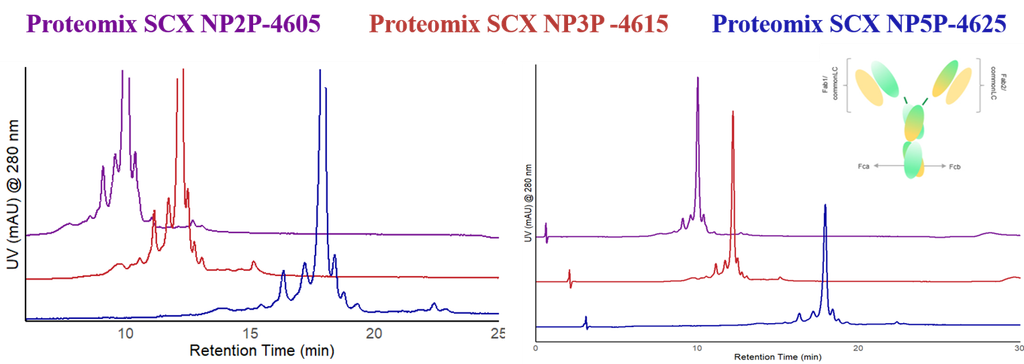
IEX provides complementary information on charge heterogeneity associated with molecular composition and modifications such as deamidation, C-terminal lysine processing and sialylation.
Sepax Proteomix SCX columns were evaluated using both pH-gradient and salt-gradient elution. The approaches generated different selectivities for the BsAb samples, supporting their use as complementary method-development options.
Comparisons across Proteomix SCX particle sizes produced consistent separation profiles. Shorter columns packed with 1.7 µm and 3 µm particles reduced analysis time while maintaining effective separation, offering useful options for laboratories balancing analytical detail with throughput.
HIC separates proteins according to differences in their accessible hydrophobic surfaces and interaction strength with a hydrophobic stationary phase. This selectivity complements the size- and charge-based information obtained from SEC and IEX.
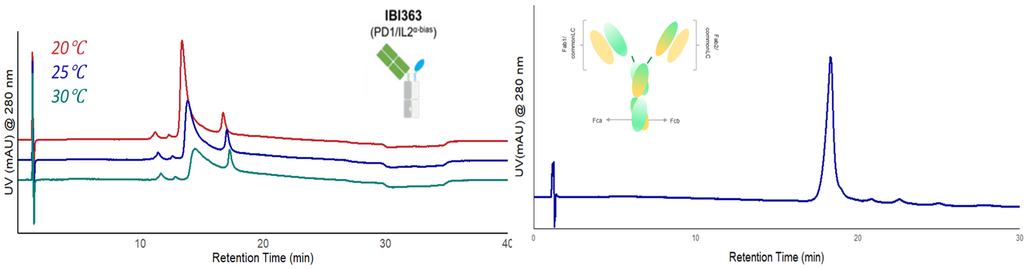
Proteomix HIC NP1.7 Phenyl provided high resolution separation based on hydrophobicity. Modified heavy-chain and light-chain species showed distinct selectivity, and temperature optimization further influenced separation performance.
The results illustrate the value of HIC for investigating BsAb heterogeneity associated with structural differences or molecular modifications that affect hydrophobic interactions.
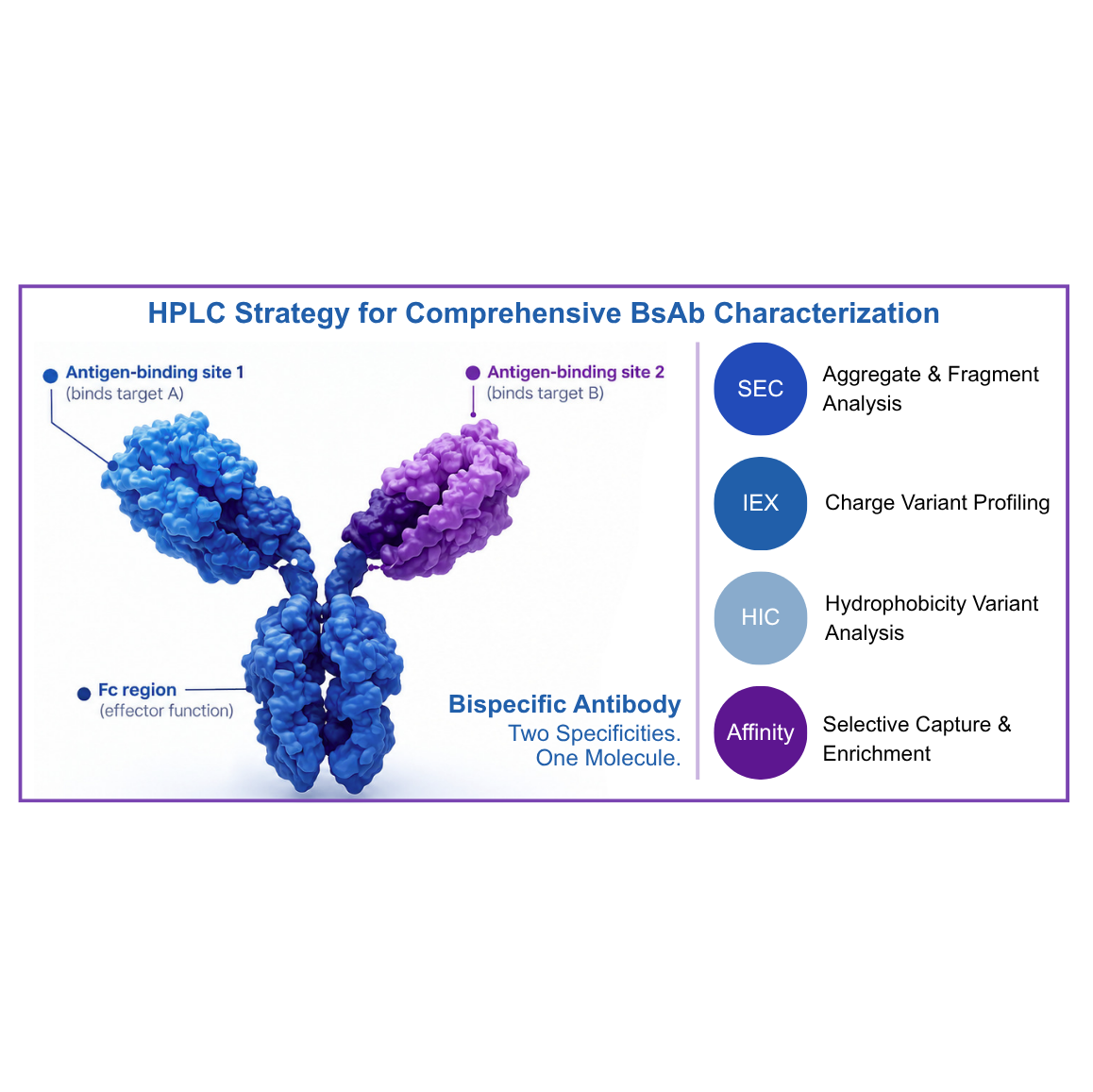
Together, these orthogonal separation methods deliver a comprehensive assessment of bispecific antibody quality by answering key operational questions:
These complementary readouts can support candidate screening, purification optimization, comparability studies and process-consistency assessment. Peak identity and quantitative performance should be confirmed as part of sample-specific method development.
BsAbs combine different binding functions within one molecular construct, creating additional possibilities for structural heterogeneity and misassembly. Sepax addresses this complexity through a coordinated set of assays rather than a single separation method.
Three features distinguish the approach:
Together, these capabilities provide a practical starting point for developing methods suited to different BsAb architectures.
From affinity-based quantification to size, charge and hydrophobicity profiling, Sepax offers comprehensive HPLC tools for investigating complex bispecific antibodies. BioMix mixed-mode SEC adds another dimension of selectivity for challenging mispairing analysis.
Download the complete Sepax BsAb poster to review the chromatograms, column configurations and experimental results.
Need help selecting columns for your BsAb? Contact your Bio-Connect account manager or our technical support team to discuss your sample, analytical priorities and a suitable Sepax HPLC strategy.


HPLC Columns | Chromatography Resins | SEC Columns | Affinity Media | Purification Services | OEM/ODM Services
We gladly support you by keeping you updated on our latest products and developments