
Meet Solis BioDyne’s next-generation FIREScript® reverse transcriptases: fast, thermostable enzymes with distinct RNase H profiles for flexible cDNA synthesis and RT-qPCR workflows.
Reverse transcription workflows do not all ask the same thing from an enzyme. Some require preservation of long or complex RNA templates, while others prioritize efficient RNA processing and sensitive RT-qPCR.
That is why the next generation of Solis BioDyne’s FIREScript® includes two reverse transcriptases with distinct RNase H profiles: FIREScript® FLEX H(-) (Cat no. #06-63) and FIREScript® ULTRA H(+) (Cat no. #06-53)
Both enzymes combine fast cDNA synthesis, high thermostability, broad working temperature ranges and stability designed for demanding laboratory workflows. The main question is: which one is better suited to your application?
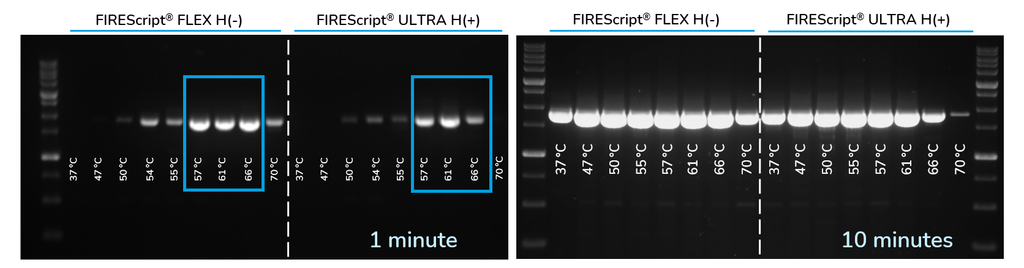
Both next-generation FIREScript® reverse transcriptases were engineered for fast and robust cDNA synthesis. They show maximum activity at elevated temperatures of approximately 57-65°C, helping with the reverse transcription of GC-rich and highly structured RNA (Figure 1). They also support rapid synthesis of long cDNA, with transcripts exceeding 12 kb demonstrated in testing.
Both enzymes also offer:
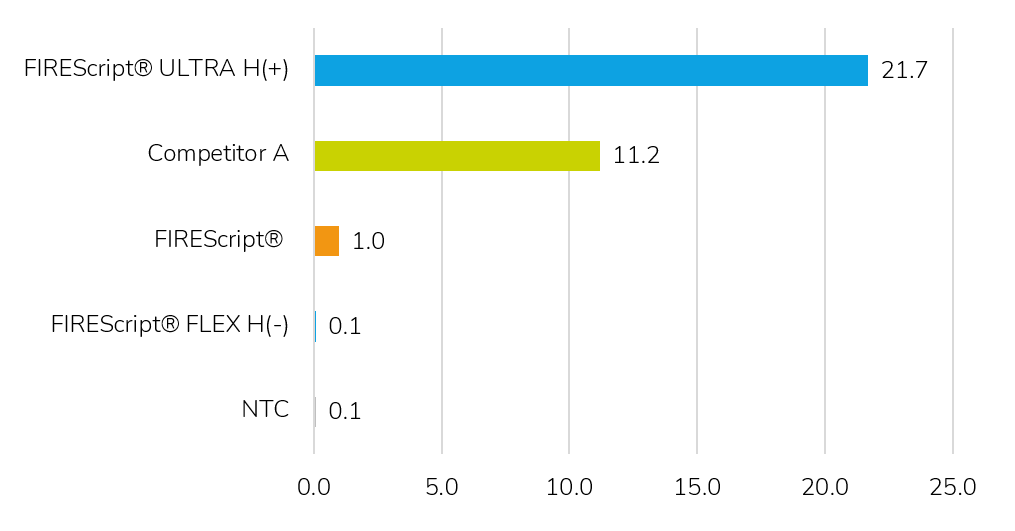
The key difference is their RNase H activity (Figure 2).
| FIREScript® FLEX H(-) (Cat no. #06-63) | FIREScript® ULTRA H(+) (Cat no.#06-53) | |
| RNase H activity | Reduced | Elevated |
| Main advantage | Preserves RNA templates during cDNA synthesis | Efficiently processes RNA templates |
| Choose it when… | Full-length cDNA and template preservation are important | Sensitive and efficient RT-qPCR is the priority |
| Particularly useful for | Long and complex RNA workflows | Gene expression and targeted RNA detection |
For a visual overview of FIREScript® FLEX H(-) and FIREScript® ULTRA H(+), including RNase H activity, thermostability, inhibitor tolerance, cDNA synthesis performance and ordering information, view the full Solis BioDyne flyer below.
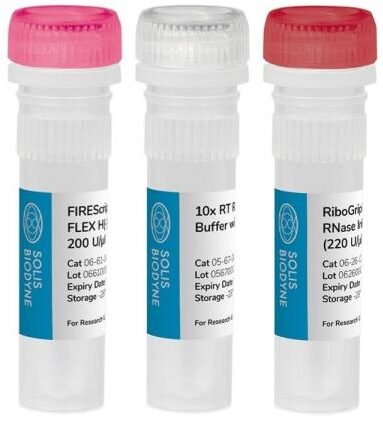
FIREScript® FLEX H(-) (Cat#06-63) has reduced RNase H activity, helping preserve RNA during reverse transcription and supporting accurate full-length cDNA synthesis.
This makes FLEX H(-) a strong choice when working with long or complex RNA templates or workflows where maintaining the integrity of the RNA hybrid is beneficial.
Its robustness also extends beyond the reaction itself. In testing, FLEX H(-) maintained reverse transcription performance after 30 minutes at 65°C, with only a minimal Cq shift compared with substantially larger changes for conventional reverse transcriptases.
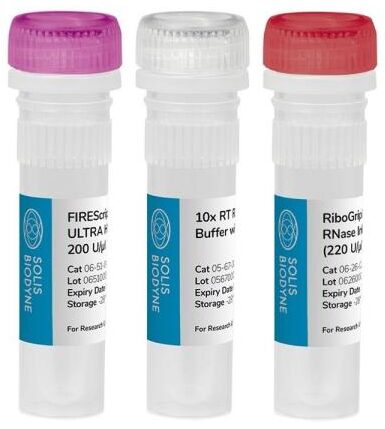
FIREScript® ULTRA H(+) (Cat#06-53) has elevated RNase H activity, enabling efficient RNA template processing and supporting high-performance RT-qPCR.
It is therefore particularly suited to workflows where sensitive RNA detection and efficient downstream qPCR are important. In comparative testing, ULTRA H(+) produced lower Cq values than the competing reverse transcriptases tested, demonstrating strong sensitivity with low-abundance RNA targets.
Until now, the new FIREScript® enzymes have been available as ready-to-use kits for convenient and reproducible reverse transcription.
From September 2026, larger kit formats will provide even more flexibility for researchers who want to optimize their own reactions. Instead of relying on a fixed all-in-one setup, users will have more freedom to adjust individual component concentrations according to their application.
This makes the FIREScript® range suitable both for researchers looking for a straightforward reverse transcription workflow and for those developing or optimizing more specialized assays.
If you need reduced RNase H activity, RNA template preservation and efficient synthesis of long or complex cDNA, start with FIREScript® FLEX H(-).
If your priority is elevated RNase H activity, efficient RNA processing and sensitive RT-qPCR, choose FIREScript® ULTRA H(+).
Whichever workflow you are running, both next-generation FIREScript® reverse transcriptases bring together speed, thermostability, inhibitor tolerance and workflow stability in one platform.
Not sure which one fits your application? Request a sample and test FIREScript® FLEX H(-) (Cat no.#06-63) or FIREScript® ULTRA H(+) (Cat no.#06-53) in your own workflow.



PCR | Enzymes and Master Mixes | qPCR: Fast, Stable at RT, Tolerant to inhibitors | cDNA | RNase Inhibitors | dNTP|LAMP | Loading Dyes | Nucleotides | DNA Ladders
We gladly support you by keeping you updated on our latest products and developments